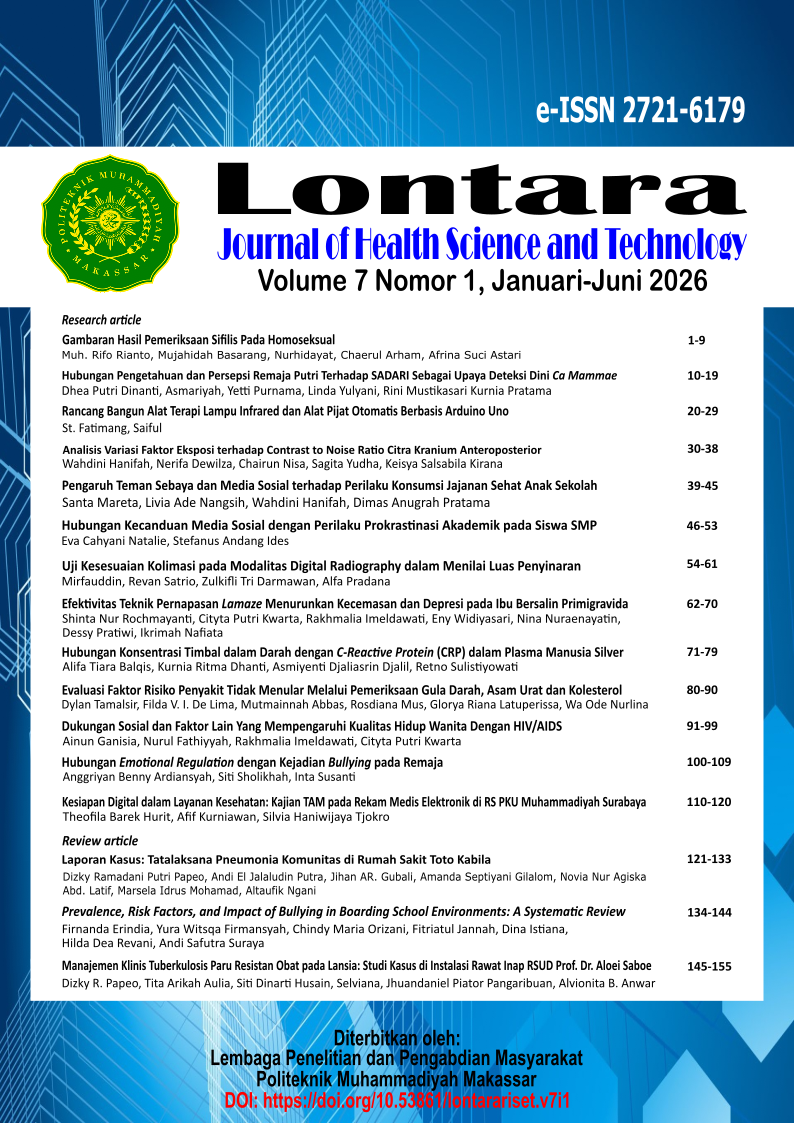
Social Support and Other Factors Affecting the Quality of Life of Women with HIV/AIDS
DOI:
https://doi.org/10.53861/lontarariset.v7i1.618Keywords:
Social Supports, Quality of Life, HIV/AIDSAbstract
People with HIV/AIDS not only need medication to reduce physical discomfort, but also need social support to overcome psychological anxiety and restlessness. Social support is critical in maintaining good physical and mental health. This study aims to analyze the social support status of women with HIV/AIDS and explore other factors that affect their quality of life in Kecamatan Patrang, Kabupaten Jember. The research method used was cross-sectional with convenience sampling and data collection through questionnaires with SSRS (Social Support Rating Scale) within three months from March to May 2025, with a sample of 92 women with HIV/AIDS. It is known that there is a significant relationship between emotional support (p = 0.01) and assessment support (p = 0.03), as well as other factors such as the duration of ARV therapy (p = 0.03), with the quality of life of women with HIV/AIDS. These findings are expected to provide a basis for interventions, including the formation of peer-support groups, counseling programs focused on strengthening self-esteem, and training for families and communities to provide appreciation and respect to women with HIV/AIDS, which ultimately improves their health and quality of life.
Downloads
References
Ameyaw, E. K., Nutor, J. J., Okiring, J., Yeboah, I., Agbadi, P., Getahun, M., Agbadi, W., & Thompson, R. G. A. (2024). The role of social support in antiretroviral therapy uptake and retention among pregnant and postpartum women living with HIV in the Greater Accra region of Ghana. BMC Public Health, 24(1), 1–9. https://doi.org/10.1186/s12889-024-18004-z
Aswar, A., Munaing, M., & Justika, J. (2020). Pengaruh Dukungan Sosial Terhadap Kualitas Hidup ODHA di Kota Makassar KDS Saribattangku. Jurnal RAP (Riset Aktual Psikologi Universitas Negeri Padang), 11(1), 80. https://doi.org/10.24036/rapun.v11i1.109551
Blandina, O. A., & Manisa, J. C. (2024). Family Support for People Living with AIDS in North Halmahera District. International Journal of Multidisciplinary Approach Research and Science, 2(03), 1294–1300. https://doi.org/10.59653/ijmars.v2i03.972
Cohen, S., & Janicki-Deverts, D. (2012). Who’s Stressed? Distributions of Psychological Stress in the United States in Probability Samples from 1983, 2006, and 2009. Journal of Applied Social Psychology, 42(6), 1320–1334. https://doi.org/10.1111/j.1559-1816.2012.00900.x
Firman, Yona, S., & Waluyo, A. (2025). Resilience, Social Support, and Quality of Life Among People Living with HIV/AIDS. Jurnal Keperawatan Indonesia, 28(1), 35–44. https://doi.org/10.7454/jki.v28i1.1337
Kalichman, S. C., Katner, H., Banas, E., Hill, M., & Kalichman, M. O. (2021). Medications among People Living with HIV in a Rural Setting. Social Science and Medicine, 258(860), 1–36. https://doi.org/10.1016/j.socscimed.2020.113092.HIV-Related
Kemenkes RI. (2020). Rencana Aksi Nasional Pencegahan dan Pengendalian HIV AIDS dan PIMS di Indonesia Tahun 2020-2024. Kementerian Kesehatan Republik Indonesia, 1–188.
Kemenpppa. (2008). Pemberdayaan Perempuan dalam Pencegahan Penyebaran HIV AIDS. Kementerian Negara Pemberdayaan Perempuan RI, 15, 1–60.
Mengistu, N., Hareru, H. E., Shumye, S., Yimer, S., Sisay, D., Kaso, A. W., Muche, T., Kassaw, C., Soboksa, N. E., Molla, W., Molla, A., & Duko, B. (2022). Health related quality of life and its association with social support among people living with HIV/AIDS receiving antiretroviral therapy in Ethiopia: a systematic review and meta-analysis. Health and Quality of Life Outcomes, 20(1), 1–8. https://doi.org/10.1186/s12955-022-01985-z
Rahayu, B., Respati, T., & . N. (2023). The Influence Service Quality and Social Support on HIV Patient Satisfaction. International Journal of Research and Review, 10(3), 22–28. https://doi.org/10.52403/ijrr.20230305
Rasni Jumliarni, Usman, & Henni Kumaladewi Hengky. (2019). Hubungan Dukungan Sosial Dengan Kualitas Hidup Orang Dengan Hiv/Aids (Odha) Di Rumah Sakit Umum Lasinrang Kabupaten Pinrang. Jurnal Ilmiah Manusia Dan Kesehatan, 2(1), 34–44. https://doi.org/10.31850/makes.v2i1.122
Şahinoglu, M. S., Kandemir, F. Ö., Alkan, S., Evik, G., & Turkegun-Şengul, M. (2024). Evaluation of Quality of Life, Anxiety and Depression in People Living with HIV. Mediterranean Journal of Infection Microbes and Antimicrobials. https://doi.org/10.4274/mjima.galenos.2024.23078.19
Santos, V. da F., Pedrosa, S. C., Aquino, P. de S., Lima, I. C. V. de, Cunha, G. H. da, & Galvão, M. T. G. (2018). Social support of people with HIV/AIDS: the Social Determinants of Health Model. Revista Brasileira de Enfermagem, 71, 625–630. https://doi.org/10.1590/0034-7167-2017-0346
Sari, Y. K., & Wardani, I. Y. (2017). Dukungan Sosial Dan Tingkat Stres Orang Dengan Hiv/Aids. Jurnal Keperawatan Indonesia, 20(2), 85–93. https://doi.org/10.7454/jki.v20i2.361
Sehati, V. C. T., & Hillers, R. T. C. (2018). Hubungan Antara Dukungan Keluarga Dengan Kualitas Hidup Pasien HIV/AIDS Yang Menjalani Terapi Di Klinik VCT RSUD dr. T.C. Hillers Maumere. 93–103.
Suwito, A., Elfitri, I., Widya, A., & Hasnita, E. (2023). Faktor Ketidakpatuhan ODHA Mengkonsumsi Antiretroviral Therapy Di Sumatera Barat Indonesia. Jurnal Endurance : Kajian Ilmiah Problema Kesehatan, 8(3), 552–567. https://doi.org/10.22216/jen.v8i3.2507
Tesfaye, T., Darega, J., Belachew, T., & Abera, A. (2019). Health-Related Quality of Life and Associated Factors Among People Living with HIV /AIDS Following ART Clinic in Jimma University Specialized Hospital, Southwest Ethiopia: A Facility- Based Cross-Sectional Study. The Open Public Health Journal, 11(1), 572–583. https://doi.org/10.2174/1874944501811010572
Thai, T. T., Nguyen, B. T., Le Nguyen, M. B. T., Tran, T. H. T., Nguyen, N. B. T., Tran, V. B., Pham, P. T. T., & Bui, H. H. T. (2025). The correlation of social support and family support with HIV-related stigma and depression in people living with HIV in Vietnam. BMC Public Health, 25(1). https://doi.org/10.1186/s12889-025-22326-x
UNAIDS. (2021). UNAIDS data 2021. Unaids, 4–38.
UNDP. (2020). Benefits of ARV Treatment. United Nations Development Programme.
White, C. N., Conway, C. C., & Oltmanns, T. F. (2020). Stress and Personality Disorders. The Oxford Handbook of Stress and Mental Health, June, 182–198. https://doi.org/10.1093/oxfordhb/9780190681777.013.8
WHO. (1996). WHOQOL-BREF: introduction, administration, scoring and generic version of the assessment: field trial version, December. In World Health Organization (pp. 1–16).
WHO. (2022). Global health sector strategies on, respectively, HIV, viral hepatitis and sexually transmitted infections for the period 2022-2030.
Xiao, Z., Li, X., Qiao, S., Zhou, Y., & Shen, Z. (2017). Social Support, Depression and Quality of Life among People Living with HIV in Guangxi, China. Physiology & Behavior, 176(1), 100–106. https://doi.org/10.1080/09540121.2016.1224298
Yang, Z., Zhang, Y., Zhang, L., Han, S., Xu, Z., & Hu, Y. (2025). Interventions and Their Effectiveness to Reduce HIV-Related Stigma Among Women Living With HIV: A Systematic Review Protocol. Health Science Reports, 8(4), 2–7. https://doi.org/10.1002/hsr2.70671
Yonita, M. R. T., Rahardjo, S. S., & Murti, B. (2020). Meta Analysis the Association between Social Support and Quality of Life of People Living with HIV/AIDS. Journal of Epidemiology and Public Health, 5(4), 435–441. https://doi.org/10.26911/jepublichealth.2020.05.04.05
Downloads
Published
How to Cite
Issue
Section
License
Copyright (c) 2026 Ainun Ganisia, Nurul Fathiyyah, Rakhmalia Imeldawati, Cityta Putri Kwarta

This work is licensed under a Creative Commons Attribution 4.0 International License.
Lontara Journal Of Health Science And Technology is licensed under Creative Commons.
The journal allows the author to hold the copyright of the article without restrictions.
The journal allows the author(s) to retain publishing rights without restrictions.
The legal formal aspect of journal publication accessibility refers to Creative Commons Attribution 4.0 International (CC BY 4.0).
The Creative Commons Attribution 4.0 International (CC BY 4.0) license allows re-distribution and re-use of a licensed work on the conditions that the creator is appropriately credited and that any derivative work is made available under “the same, similar or a compatible license”. Other than the conditions mentioned above, the editorial board is not responsible for copyright violations.