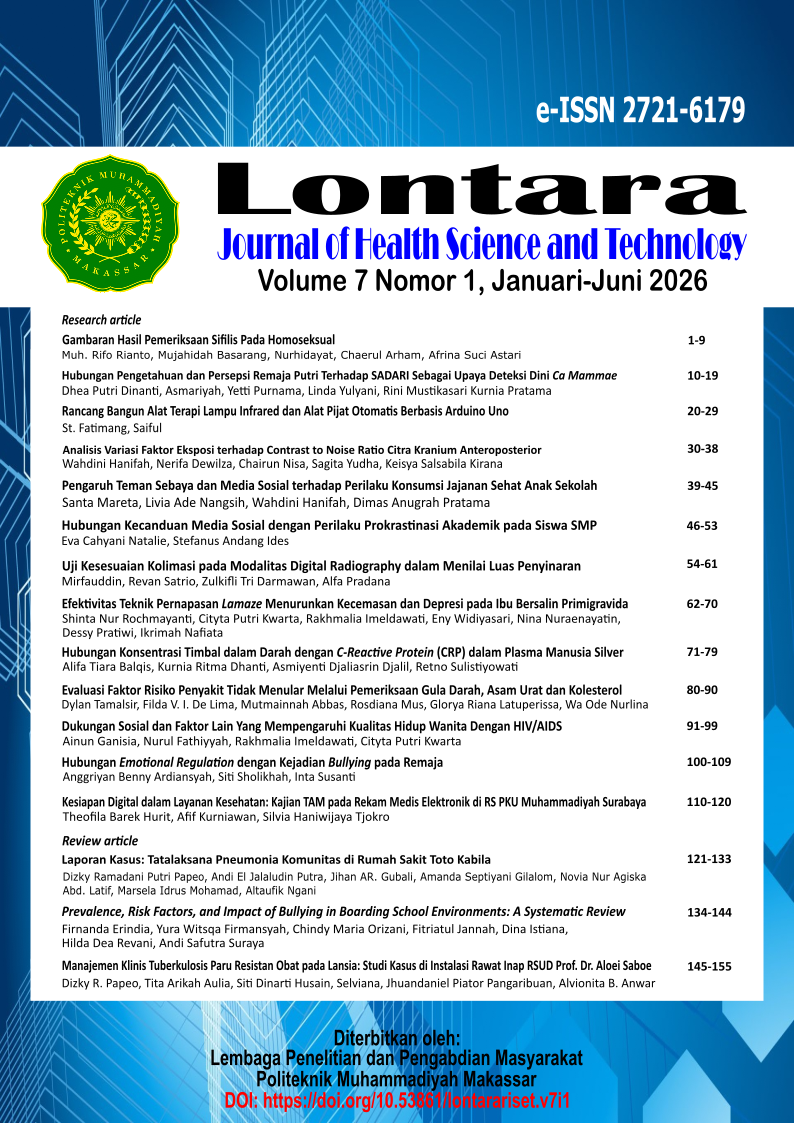
Effectiveness of the Lamaze Breathing Technique in Reducing Anxiety and Depression in Primiparous Mothers
DOI:
https://doi.org/10.53861/lontarariset.v7i1.611Keywords:
Lamaze breathing technique, anxiety, depression, primigravid mothersAbstract
Childbirth is a process involving hormonal changes, emotional stress, and significant physical challenges. One notable factor is the emotional stress that can induce anxiety and depression, particularly in primigravid mothers. Some efforts are needed to address this problem, one them is the use of the Lamaze breathing technique. This study aims to determine the effectiveness of the Lamaze breathing technique in reducing labor pain, thereby impacting maternal anxiety and depression. The study employed a quasi-experimental design with a pre-test and post-test approach. The study sample consisted of 40 primigravid mothers, randomly assigned to either the intervention group (n=20), which received Lamaze breathing technique training, or the control group (n=20), which received standard midwifery care. The results of the study demonstrated a significant decrease in anxiety and depression scores in the intervention group following the Lamaze breathing technique training (p<0.001), and no significant changes in anxiety scores (p = 0.672) and depression scores (p = 0.785) in the control group. It can be concluded that the Lamaze breathing technique is effective in reducing anxiety and depression levels in primiparous mothers.
Downloads
References
Aaron T., B. (1996). Beck’s Depression Inventory. The Psychological Corporation.
Adhikari, K., & Devi, S. (2022). Effect of lamaze breathing and psychosomatic relaxation techniques on labour pains and its outcome. International Journal of Health Sciences, 6714–6721. https://doi.org/10.53730/ijhs.v6ns4.10369
Aldinger, J. K., Abele, H., & Kranz, A. (2024). Prenatal Maternal Psychological Stress (PMPS) and Its Effect on the Maternal and Neonatal Outcome: A Retrospective Cohort Study. Healthcare (Switzerland), 12(23). https://doi.org/10.3390/healthcare12232431
Amelia, F., & Rahayuningsih, T. (2023). Penatalaksanaan Teknik Relaksasi Lamaze dan Aromaterapi Jasmine dengan Masalah Nyeri Akut Persalinan Kala 1 Fase Aktif di Rumah Edukasi Persalinan Alami Sukoharjo. Healthy Indonesian Journal, 2(3).
Durairaj, S., Ethiraj, T., Rajendran, S. S., Vijayalakshmi, V., Carmel, J., Alexander, R., Kannan, B., Raja, S., & Shanmugam, S. (2024). Effectiveness of Lamaze Breathing on Comfort, Labour Pain, and Anxiety Among Primigravida Mothers During the Active Stage of Labour: A Quasi-Experimental Study. Frontiers in Health Informatics, 13(3). www.healthinformaticsjournal.com
Hamdy Nasr, E., Soliman Rashed, M., Ali Nour, S., Salah El-Din Mohamed, H., Ragaa Ragab, A., Nagat Salah Salama, A., & Elsayda Hamdy Nasr, A. (2023). Professor of Obstetrics and Gynecology-Faculty of Nursing-Zagazig University 2,3 Professor of Reproductive Health-International Islamic. In Port Said Scientific Journal of Nursing (Vol. 10, Issue 2). https://www.researchgate.net/publication/382912508
Hamilton M. (1959). The assessment of anxiety states by rating. Br J Med Psychol, 32, 50–55.
Jhala, A. (2017). A Study to Assess the Effectiveness of Lamaze Breathing on Labor Pain and Anxiety Towards Labor Outcome among Primigravida Mothers During Labor in Community Health Center, Kolar Road, Bhopal (M.P.). Indian Journal of Obstetrics and Gynecology, 5(1), 19–22. https://doi.org/10.21088/ijog.2321.1636.5117.2
Karkada, S. R., Noronha, J. A., & Bhat, S. K. (2024). Impact of Lamaze Breathing on Childbirth Comparison Between Primigravid and Multigravid Women. National Journal of Community Medicine, 15(6), 483–486. https://doi.org/10.55489/njcm.150620243901
Marwiyah, N., Suwardiman, D., Kurnia Mutia, H., Ayu Alkarimah, N., Rahayu, R., & Uzzakiyyah, I. (2022). Faktor Determinan yang Mempengaruhi terjadinya Postpartum Blues pada Ibu Nifas. Faletehan Health Journal, 9(1), 89–99. www.journal.lppm-stikesfa.ac.id/ojs/index.php/FHJ
Nori, W., Kassim, M. A. K., Helmi, Z. R., Pantazi, A. C., Brezeanu, D., Brezeanu, A. M., Penciu, R. C., & Serbanescu, L. (2023). Non-Pharmacological Pain Management in Labor: A Systematic Review. In Journal of Clinical Medicine (Vol. 12, Issue 23). Multidisciplinary Digital Publishing Institute (MDPI). https://doi.org/10.3390/jcm12237203
SHAHEEN, T., MUI, L., & NORDIN, R. (2024). Effectiveness of Back Massage & Lamaze Breathing on Labor Outcomes Among Primigravida in Tertiary Care Hospitals, Lahore Pakistan: A Randomized Control Trial. Biological and Clinical Sciences Research Journal, 2024(1), 879. https://doi.org/10.54112/bcsrj.v2024i1.879
Silva, C. B. D. O., Rodrigues, K. M. D., Zoldan, C., Nomura, R. M. Y., Araujo Júnior, E., & Peixoto, A. B. (2023). Nonpharmacological Methods to Reduce Pain during Active Labor in A Real-life Setting. Revista Brasileira de Ginecologia e Obstetricia, 45(1), 3–10. https://doi.org/10.1055/s-0042-1759629
Varney, H. (2018). Varney’s Midwifery - Tekoa L. King, Mary C. Brucker, Kathryn Osborne, Cecilia M. Jevitt - Google Books. Jones & Bartlett Learning. https://books.google.co.id/books/about/Varney_s_Midwifery.html?id=tGNaDwAAQBAJ&redir_esc=y
WHO. (2022). WHO recommendations on maternal and newborn care for a positive postnatal experience. World Health Organization.
Yesildag, B., & Golbasi, Z. (2024). Effects of the web-based birth preparation programme and motivational interviews on primigravida women: Randomized-controlled study. International Journal of Nursing Practice, 30(1). https://doi.org/10.1111/ijn.13207
Youssef, N. K., Mostafa, M. F., & Ibrahim, W. H. (2025). Effect of Implementing Childbirth Preparation Classes on Women’sSelf-efficacy and Pregnancy Outcomes. Malaysian Journal of Nursing, 16(3), 98–108. https://doi.org/10.31674/mjn.2025.v16i03.010
Downloads
Published
How to Cite
Issue
Section
License
Copyright (c) 2026 Shinta Nur Rochmayanti, Cityta Putri Kwarta, Rakhmalia Imeldawati, Eny Widiyasari, Nina Nuraenayatin, Dessy Pratiwi, Ikrimah Nafiata

This work is licensed under a Creative Commons Attribution 4.0 International License.
Lontara Journal Of Health Science And Technology is licensed under Creative Commons.
The journal allows the author to hold the copyright of the article without restrictions.
The journal allows the author(s) to retain publishing rights without restrictions.
The legal formal aspect of journal publication accessibility refers to Creative Commons Attribution 4.0 International (CC BY 4.0).
The Creative Commons Attribution 4.0 International (CC BY 4.0) license allows re-distribution and re-use of a licensed work on the conditions that the creator is appropriately credited and that any derivative work is made available under “the same, similar or a compatible license”. Other than the conditions mentioned above, the editorial board is not responsible for copyright violations.