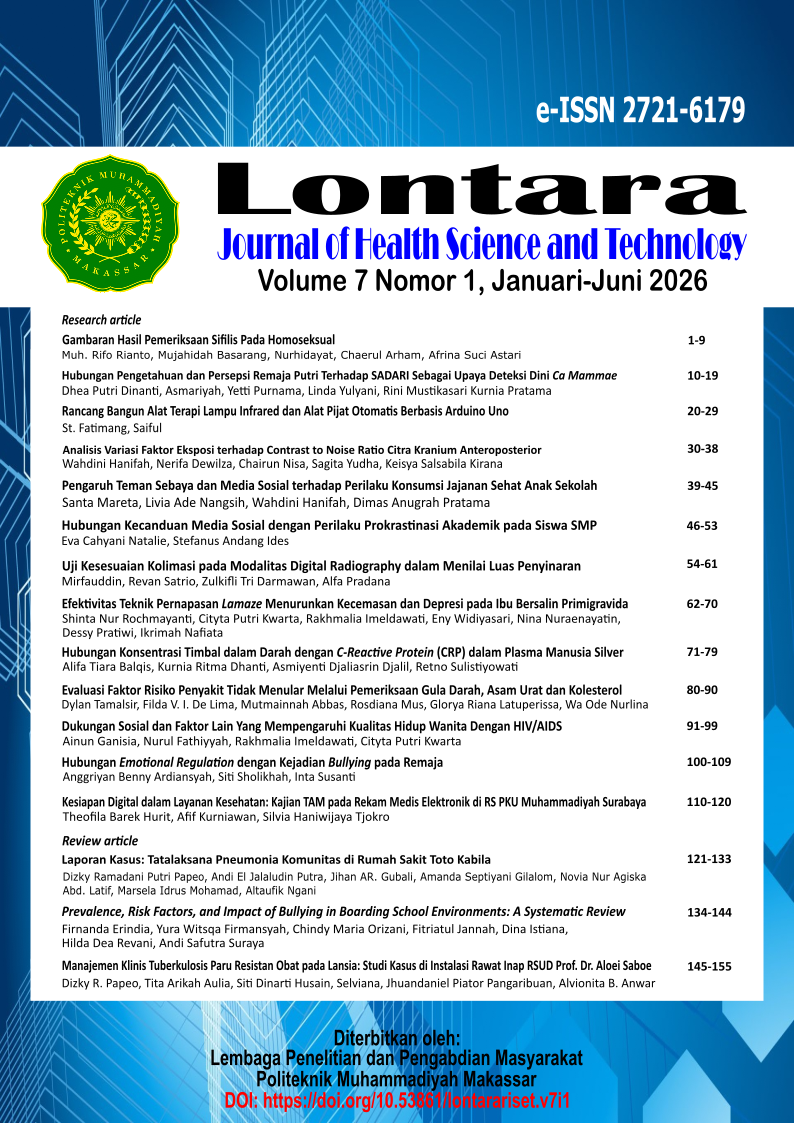
Relationship Between Social Media Addiction and Academic Procrastination Behavior in Junior High School Students
DOI:
https://doi.org/10.53861/lontarariset.v7i1.608Keywords:
Social Media Addiction, Academic Procrastination, StudentsAbstract
The rapid development of technology every year causes internet usage activities in Indonesia to continue to increase. This is also caused by the availability of various social media platforms that hurt students, one is social media addiction which can interfere with students concentration and study time. This study aims to determine the correlation between social media addiction and academic procrastination behavior in students at SMPN 21 Bekasi. Quantitative descriptive research with a cross-sectional approach. The sample in this study were students in grades VII and VIII totaling 97 people and using purposive sampling technique. The research was at SMPN 21 Bekasi in November 2024. The research used a questionnaire distributed via google form with the kendall tau b statistical test. The results of this study show that students are addicted to high social media (54,6%) and moderate academic procrastination behavior (52,6%). There is a correlation between social media addiction and academic procrastination behavior in students at SMPN 21 Bekasi with a p-value of 0.000 < (0.005). It is hoped that students can control themselves, reduce their use of social media, and try to manage their time in academic or non-academic activities. This can help them reduce their level of social media addiction and academic procrastination.
Downloads
References
Adilla, P. N., & Lubis, W. U. (2024). Pengaruh Penggunaan Sosial Media Terhadap Prokrastinasi Akademik Siswa Di Sma Negeri 2 Medan. Jurnal Indopedia (Inovasi Pembelajaran Dan Pendidikan), 2(1), 133–152.
Aprilia, R., Sriati, A., & Hendrawati, S. (2020). Tingkat Kecanduan Media Sosial pada Remaja. Journal of Nursing Care, 3(1), 41–53. https://doi.org/10.24198/jnc.v3i1.26928
Asosiasi Penyelenggara Jasa Internet Indonesia (APJII). (2024). APJII Jumlah Pengguna Internet Indonesia Tembus 221 Juta Orang. APJII. https://apjii.or.id/berita/d/apjii-jumlah-pengguna-internet-indonesia-tembus-221-juta-orang
Dharma, A. M. (2020). Prokrastinasi Akademik Di Kalangan Mahasiswa Program Studi Dharma Acarya. Jurnal Pendidikan, Sains Sosial, Dan Agama, 6(1), 64–78. https://doi.org/10.53565/pssa.v6i1.160
Ghufron, M. N., & Risnawita, Rini, S. (2010). Teori-Teori Psikologi. Ar-Ruzz Media.
Haloho, N. B. (2023). Hubungan Kecanduan Gadget Dengan Perilaku Prokrastinasi Pada Siswa SMA Mulia Pratama Medan. Skripsi Fakultas Psikologi Universitas Medan Area, 1–124. https://repositori.uma.ac.id/handle/123456789/19695%0Ahttps://repositori.uma.ac.id/bitstream/123456789/19695/2/168600288 - Nora br. Haloho - Fulltext.pdf
Kartadinata, I., & Sia, T. (2008). Prokrastinasi Akademik dan Manajemen Waktu. Indonesian Psychological., 23, 3.
Kuss, D. J., & Pontes, H. M. (2019). Internet Addiction; advances in psychotherapy evidence-based practice.
Kusuma Rini, M., & Huriah, T. (2020). Prevalensi dan Dampak Kecanduan Gadget Pada Remaja: Literature Review. Jurnal Keperawatan Muhammadiyah, 5(1), 185–194. https://doi.org/10.30651/jkm.v5i1.4609
Lutfiah, V., & Maunah, B. (2023). Pengaruh Media Sosial Instagram Terhadap Perilaku Prokrastinasi Akademik Siswa Pada Mata Pelajaran Ips. JIIPSI: Jurnal Ilmiah Ilmu Pengetahuan Sosial Indonesia, 3(2), 179–186. https://doi.org/10.21154/jiipsi.v3i2.1754
Masfufah, M. L., Budiono, A. N., & Swastinah, T. (2023). Hubungan Intensitas Penggunaan Media Sosial Dengan Prokrastinasi Akademik Siswa Kelas X Ips Ma Ma’Arif Annur Jember Tahun Pelajaran 2022/2023. Ristekdik : Jurnal Bimbingan Dan Konseling, 8(4), 568. https://doi.org/10.31604/ristekdik.2023.v8i4.568-574
McCloskey, J. D. (2011). Finally, My Thesis on Academic Procrastination. The University of Texas at Arlington.
Novita, D., & Kristiono, N. (2023). Faktor Dan Dampak Perilaku Prokrastinasi Akademik Siswa Pada Mata Pelajaran PPKn Di SMP Negeri 7 Brebes. Jurnal Ilmiah Dan Karya Mahasiswa, 1(5), 238–252. https://jurnal.itbsemarang.ac.id/index.php/JIKMA/article/view/830
Pata, A., Aspin, A., & Pambudhi, Y. A. (2021). Kontrol Diri Siswa Terhadap Kecanduan Media Sosial. Jurnal Sublimapsi, 2(2), 20. https://doi.org/10.36709/sublimapsi.v2i2.16279
Rahimaniar, I., & Nuryono, W. (2021). Studi Kepustakaan Tentang Faktor Penyebab dan Penanganan Kecanduan Media Sosial. BK UNESA, 12(2), 185–196. https://openjournal.wdh.ac.id/index.php/edudharma/article/view/424
Rahmah, A. (2021). Kontribusi Antara Internet Addiction Dan Penggunaan Media Sosial Terhadap Proktastinasi Akademik Pada Siswa Kelas XI Di Sma Negeri 2 Banjarmasin. Jurnal Pelayanan Bimbingan Dan Konseling, 4(2), 78–87.
Statista. (2024). Social Media Addiction Statistics For 2024.
Suherman, S. S. (2023). Faktor-faktor Penyebab Prokrastinasi Akademik Siswa. 3–7.
Yenny, & Astuti, S. (2021). Hubungan antara penggunaan media sosial dengan kesepian dan perilaku perbandingan sosial. Jurnal Psikohumanika, 1, 68–81.
Downloads
Published
How to Cite
Issue
Section
License
Copyright (c) 2026 Eva Cahyani Natalie, Stefanus Andang Ides

This work is licensed under a Creative Commons Attribution 4.0 International License.
Lontara Journal Of Health Science And Technology is licensed under Creative Commons.
The journal allows the author to hold the copyright of the article without restrictions.
The journal allows the author(s) to retain publishing rights without restrictions.
The legal formal aspect of journal publication accessibility refers to Creative Commons Attribution 4.0 International (CC BY 4.0).
The Creative Commons Attribution 4.0 International (CC BY 4.0) license allows re-distribution and re-use of a licensed work on the conditions that the creator is appropriately credited and that any derivative work is made available under “the same, similar or a compatible license”. Other than the conditions mentioned above, the editorial board is not responsible for copyright violations.