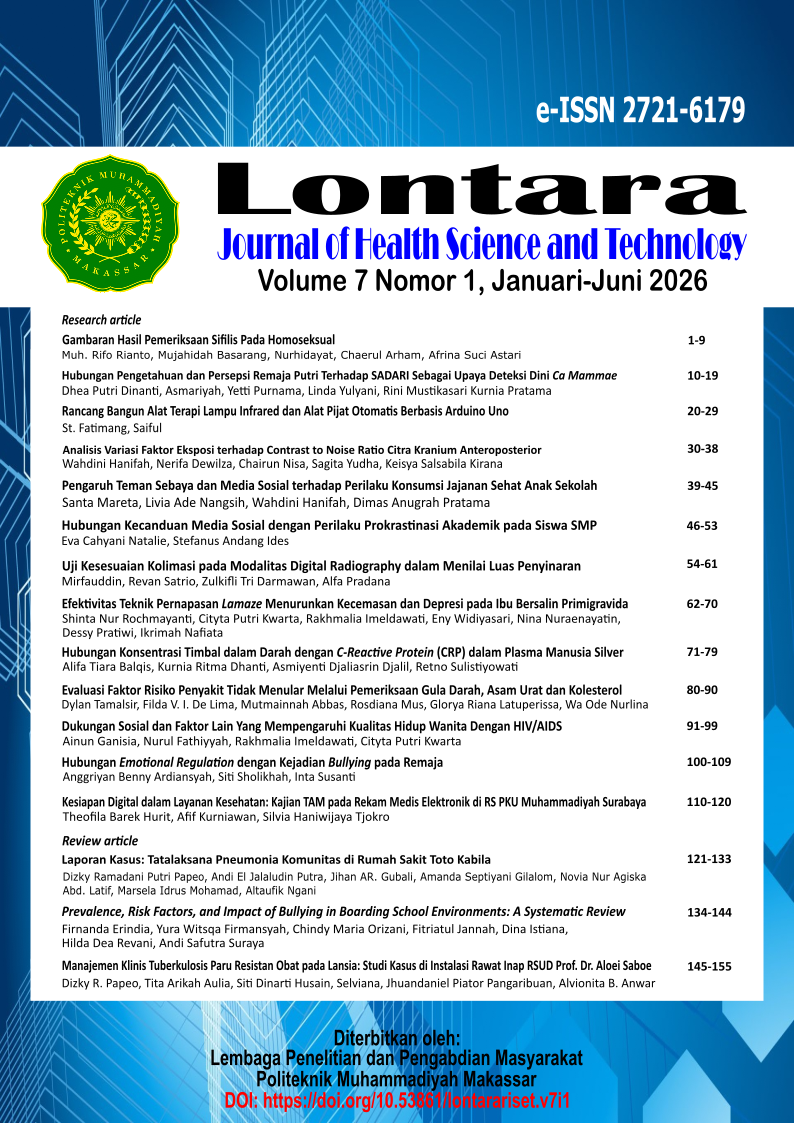
Peers and Social Media Exposure with Healthy Snack Consumption Behavior in School-Aged Children
DOI:
https://doi.org/10.53861/lontarariset.v7i1.605Keywords:
peer influence, social media exposure, healthy snacking behavior, school childrenAbstract
School children's snacks (PJAS) refer to foods and beverages consumed by children during school hours and may be influenced by social factors around them. Peer groups and social media are two factors that can shape children's healthy snacking behavior. This study aims to determine the relationship between peer influence and social media exposure with healthy snacking behavior among elementary school students. This study used a quantitative design with a cross-sectional approach. A total of 43 sixth-grade students at SDN Palumbonsari II, Karawang, were selected using purposive sampling. Data were collected through questionnaires and analyzed using univariate and bivariate analysis with the chi-square test. The results showed that most respondents had good peer relationships (74.4%) and were exposed to social media (81.4%). However, the chi-square test results showed no significant relationship between peer influence and healthy snacking behavior (p = 0.434), nor between social media exposure and healthy snacking behavior (p = 0.826). The conclusion of this study is that there is no significant relationship between peer influence and social media exposure with healthy snacking behavior among students at SDN Palumbonsari II.
Downloads
References
Amalia, S. N. I., Octaria, Y. C., Maryusman, T., & Imrar, I. F. (2023). The Associations Between Social Media Use with Eating Behavior, Physical Activity, and Nutrition Status among Adolescents in DKI Jakarta. Amerta Nutrition, 7(2SP), 193–198. https://doi.org/10.20473/amnt.v7i2SP.2023.193-198
Arisdanni, H., & Buanasita, A. (2018). Hubungan Peran Teman, Peran Orang Tua,Besaran Uang Saku dan Persepsi Terhadap Jajanan Dengan Kejadian Gizi Lebih Pada Anak Sekolah (Studi di SD Negeri Ploso 1/172 Kecamatan Tambaksari Surabaya Tahun 2017). Amerta Nutrition, 2(2), 189. https://doi.org/10.20473/amnt.v2i2.2018.189-196
Ashara, R., Wahab, A., Siregar, A., Andini, J., Fajri, M., Faisal, M., Maulana, I., Aripin, M. S., Sari, P. A., Octaviano, A., & Kom, M. (2022). Penyuluhan Penggunaan Sosial Media Yang Sehat dan Aman Terhadap Siswa SD Negeri Pamulang Timur 01. 3, 398–400.
Badriyah, L. U., Ekaningrum, A. Y., & Khulaidah, F. R. (2024). Hubungan Pengetahuan Gizi, Keterpaparan Iklan Media Sosial Dan Peer Group Support Terhadap Pemilihan Makanan Sehat Pada Remaja Sman 9 Tangerang Tahun 2023. The Journal of Nutrition and Culinary, 5(2).
Kementerian Kesehatan RI. (2018). Survei Konsumsi Pangan. Jakarta (ID): Badan Penelitian dan Pengembangan Kesehatan Kementerian RI.
Lindawati. (2019). Pengaruh Teman Sebaya Terhadap Perilaku Jajan Sehat. Medikes (Media Informasi Kesehatan), 6(1), 61–68.
Muhimah, H., & Farapti, F. (2023). Ketersediaan dan Perilaku Konsumsi Makanan Jajanan dengan Status Gizi pada Anak Sekolah Dasar. Media Gizi Kesmas, 12(1), 575–582. https://doi.org/10.20473/mgk.v12i1.2023.575-582
Rahmasari, F. A., Ismah, Z., & Agustina, D. (2024). Hubungan Teman Sebaya dan Paparan Media Sosial dengan Perilaku Fast Food Pada Siswa. MAHESA : Malahayati Health Student Journal, 4(8), 3105–3119. https://doi.org/10.33024/mahesa.v4i8.15555
Rahmawaty, S., Tamba, E. H., & Usiono. (2025). Peran Media Sosial dalam Meningkatkan Kesadaran Kesehatan Masyarakat. Jurnal Penelitian Pendidikan Indonesia, 2(2), 278–281.
Widianingtyas, S. I., & Dinda, Y. (2022). Pengaruh Teman Sebaya dengan Perilaku Jajan pada Anak Usia Sekolah. Adi Husada Nursing Journal, 8(1), 22. https://doi.org/10.37036/ahnj.v8i1.211
Downloads
Published
How to Cite
Issue
Section
License
Copyright (c) 2026 Rika Apriani Pitaloka, Milliyantri Elvandari, Linda Riski Sefrina

This work is licensed under a Creative Commons Attribution 4.0 International License.
Lontara Journal Of Health Science And Technology is licensed under Creative Commons.
The journal allows the author to hold the copyright of the article without restrictions.
The journal allows the author(s) to retain publishing rights without restrictions.
The legal formal aspect of journal publication accessibility refers to Creative Commons Attribution 4.0 International (CC BY 4.0).
The Creative Commons Attribution 4.0 International (CC BY 4.0) license allows re-distribution and re-use of a licensed work on the conditions that the creator is appropriately credited and that any derivative work is made available under “the same, similar or a compatible license”. Other than the conditions mentioned above, the editorial board is not responsible for copyright violations.