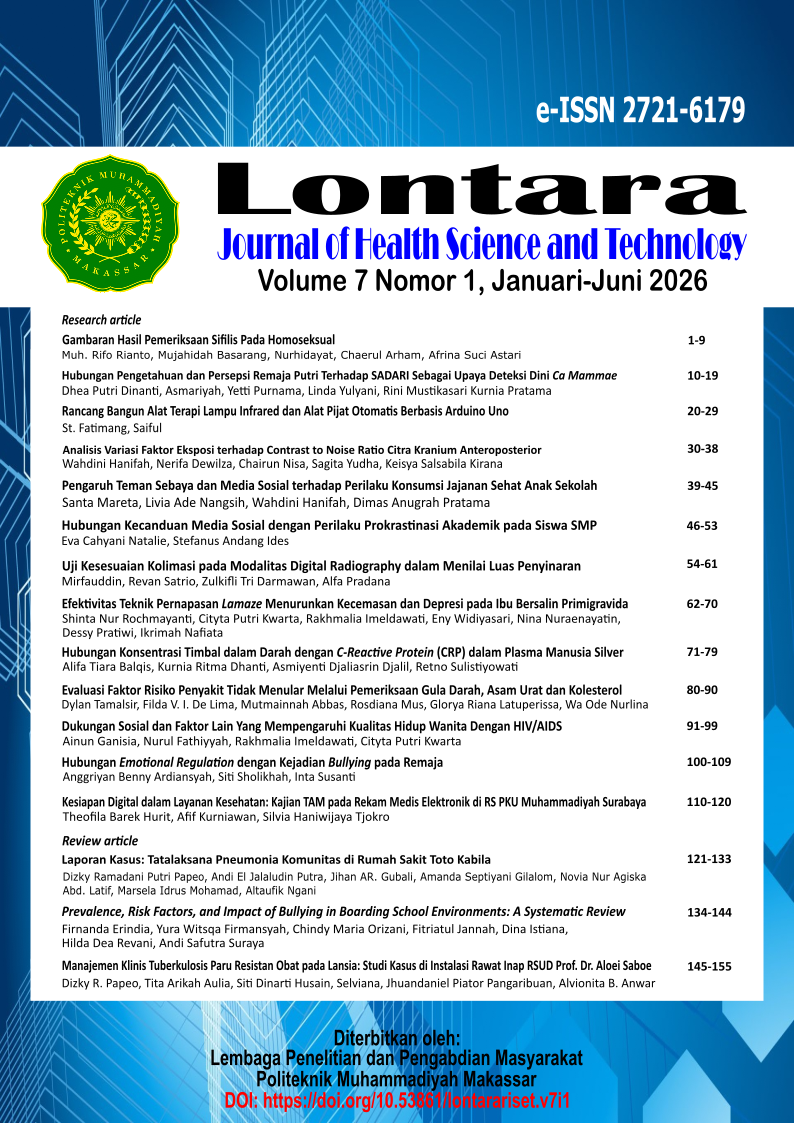
Overview of Syphilis Test Results in Homosexuals
DOI:
https://doi.org/10.53861/lontarariset.v7i1.493Keywords:
Homosexuality, Syphilis, STIsAbstract
One of the sexually transmitted infections is syphilis which is caused by the bacterium Treponema palidum which can be transmitted through sexual intercourse and direct contact with the patient's body fluids. Homosexuality is sexual attraction in the form of disorientation of a sexual partner, namely a person's tendency to engage in sexual behavior with the same sex. Sexual intercourse carried out by homosexuals can be at risk of sexually transmitted diseases. The purpose of this study was to determine the transmission of syphilis to homosexuals. The method of this research is observation with the accidental sampling technique of 50 samples using the immunochromatographic examination method. The results of the study showed that out of 50 samples, 14 samples were positively infected with syphilis. So it can be concluded that homosexuals are at high risk of contracting the sexually transmitted disease syphilis
Downloads
References
Achdiat, Adi, Pati, et all. (2019), Tingkat Pengetahuan Penyakit Infeksi Menular Seksual Dan Komplikasinya Pada Siswa Sekolah Menengah Atas Jatinagor, Jurnal Aplikasi Jurnal Ipteks Untuk Masyarakat, Vol.8 No.1. Maret 2019
Adiyanti, S.S. (2015). Pre Analitik Hemlostasis. Universitas Indonesia Yogyakarta.
Ardiansyah, Hendra. Utami,Diyah (2016). Dramaturgi mencari pasangan pada kaum homoseksual (gay). Surabaya
Azis, Nurul Niʼma. (2019). Penuntun Praktikum Flebotomi. Makassar Poltekkes Muhammadiyah Makassar.
Conters for Disease Control and Preventation. (2017). What Gay and Bisexual Men Need to Know About Sexually Transmitted Diseases. USA
Doktersehat,com. (2022), Sifilis-Prevalensi di Kalangan Homoseksual. PT. Media Kesehatan Indonesia
Djuanda A, Hamzah M, Aisah S (eds) (2013). Ilmu Penyakit Kulit dan Kelamin. Edisi ke-6. Jakarta: badanPenerbit FKUI;2013. P. 122-3.
Dewi, K.I. Permata, dan Silayukti, Kayika, Agung, Ari, Agung, Anak. (2020). Gambaran Prevalensi Penderita Sifilis Laten, Sekunder, dan PrimerPada Pasien Infeksi Menular Seksual (IMS) di Poliklinik Kulit danKelamin RSUDMangusada, Bandung, Bali periode 2017-2018 .Intisari Sains Medis 11(12): 457-460.
Kemkes.go.id, (2022), Laporan Eksekutif Perkembangan HIV AIDS dan Penyakit Infeksi Menular Seksual (PIMS) Triwulan I Tahun 2022. Kementerian Kesehatan.
Luky. 2016. Prevalensi Riwayat Sifilis dan Riwayat kontak Seksual. Yogyakarta.
Mastuti, Endah, Ratri. Winarno, Djati, Rachmad. Hastuti, Widyo Lita, (2012), Pembentukan Identitas Orientasi Seksual Pada Remaja Gay, Prediksi, Kajian Ilmiah Psikologi - No. 2, Vol . 1 , Juli - Desember 2012, 194 – 197
Nurin, Fajarina, (2024), Sifilis (Raja Singa), Hellosehat.com, Hello Health Group Pte. Ltd
Oslon, K. R., dan Ernesto De Nardin. (2017). Imunologi dan Serologi KlinisModern. Jakarta: EGC.
PKBI-Jatim.or.id, (2024), Infeksi Menular Seksual (IMS): jenis, penyebab, gejala, dan pencegahan.
Rosaria, Wulan, Yohana & Nurhayati, Titi, (2017) Faktor-faktor Yang Berhubungan Dengan Orientasi Seksual Pada Remaja, Jurnal Pendidikan Kesehatan Vol 6, NO.2, Oktober 2017 : 113-121
Syahrini, (2019). Hubungan Perilaku Seksual dengan Infeksi Menular Seksual yang Dideteksi dengan Pemeriksaan Serologi pada Laki-Laki Seks dengan Laki-Laki (LSL). Sumatera Utara
Downloads
Published
How to Cite
Issue
Section
License
Copyright (c) 2026 Muh. Rifo Rianto, Mujahidah Basarang, Nurhidayat Nurhidayat, Chaerul Arham, Afrina Suci Astari

This work is licensed under a Creative Commons Attribution 4.0 International License.
Lontara Journal Of Health Science And Technology is licensed under Creative Commons.
The journal allows the author to hold the copyright of the article without restrictions.
The journal allows the author(s) to retain publishing rights without restrictions.
The legal formal aspect of journal publication accessibility refers to Creative Commons Attribution 4.0 International (CC BY 4.0).
The Creative Commons Attribution 4.0 International (CC BY 4.0) license allows re-distribution and re-use of a licensed work on the conditions that the creator is appropriately credited and that any derivative work is made available under “the same, similar or a compatible license”. Other than the conditions mentioned above, the editorial board is not responsible for copyright violations.