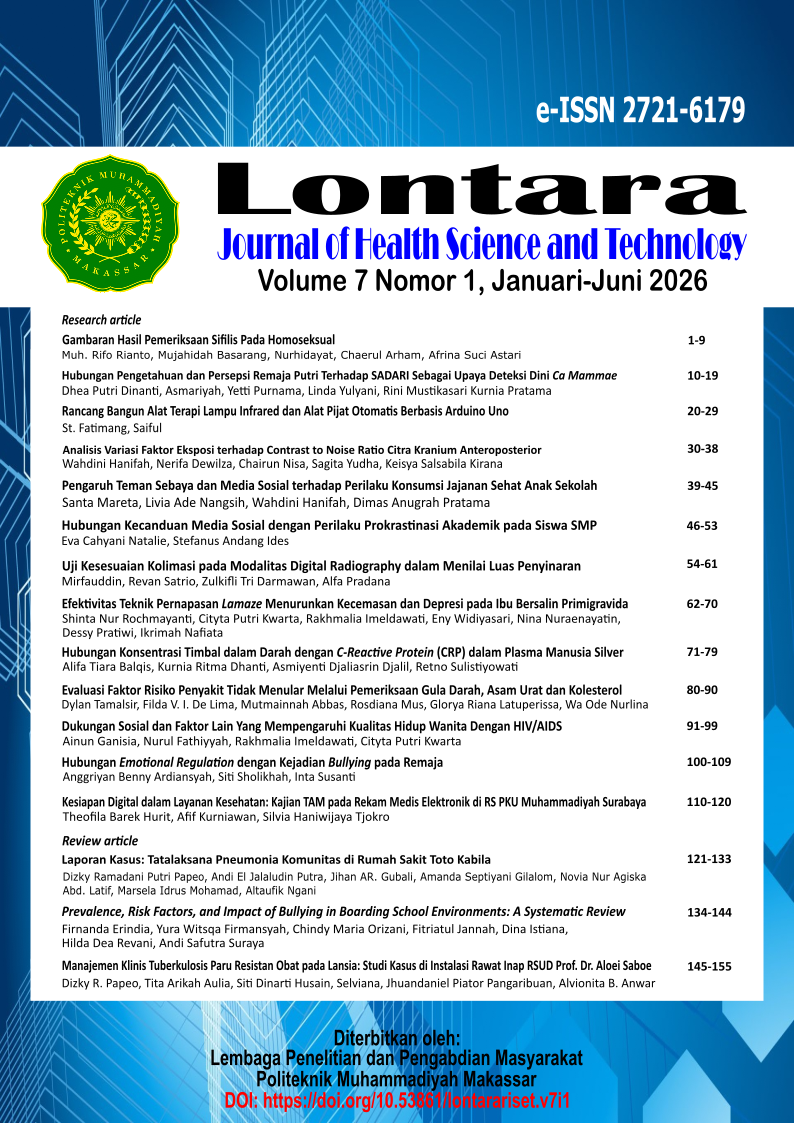
Hubungan Konsentrasi Timbal dalam Darah dengan C-Reactive Protein (CRP) dalam Plasma Manusia Silver
DOI:
https://doi.org/10.53861/lontarariset.v7i1.613Kata Kunci:
C-Reactive Protein, Manusia Silver, TimbalAbstrak
Manusia silver merupakan orang yang melumuri hampir seluruh tubuhnya menggunakan cat berwarna silver, cat yang digunakan biasanya mengandung banyak senyawa toksik salah satunya timbal (Pb). Timbal yang terakumulasi di dalam tubuh dapat menyebabkan gangguan respon inflamasi. Penelitian ini dilakukan untuk mengetahui hubungan konsentrasi timbal dalam darah dengan C-Reactive Protein (CRP) dalam serum manusia silver. Desain penelitian ini merupakan observasional analitik menggunakan pendekatan cross-sectional. Variabel dalam penelitian ini dibagi menjadi dua, kadar timbal dalam darah sebagai variabel bebas dan CRP dalam serum sebagai variabel terikat. Populasi penelitian ini merupakan manusia silver di daerah Purwokerto dan Purbalingga. Sampel dalam penelitian ini berupa 11 orang manusia silver yang diambil dengan menggunakan teknik accidental sampling. Kadar timbal dalam darah manusia silver diukur menggunakan alat spektrofotometer serapan atom (SSA), sedangkan untuk pemeriksaan CRP dilakukan menggunakan metode kualitatif (aglutinasi lateks). Hasil penelitian ini menunjukkan tidak ditemukan adanya hubungan konsentrasi timbal dalam darah dengan CRP dalam serum manusia silver, Fisher’s Exact Test P value=0,491 (P>0,05).
Unduhan
Referensi
Abadin, H., Taylor, J., Buser, M., Scinicariello, F., Przybyla, J., Klotzbach, J. M., Diamond, G. L., Citra, M., Chappel, L. L., & Mcllroy, L. A. (2020). Toxicological profile for Lead (A. for T. S. and D. R. (US); (ed.); 2020th ed., Issue August). (US);, Agency for Toxic Substances and Disease Registry.
Ardillah, Y. (2016). Faktor Resiko Kandungan Timbal di Dalam Darah. Jurnal Ilmu Kesehatan Masyarakat, 7(3), 150–155. https://doi.org/10.26553/jikm.2016.7.3.150-155
Collin, M. S., Venkatraman, S. K., Vijayakumar, N., Kanimozhi, V., Arbaaz, S. M., Stacey, R. G. S., Anusha, J., Choudhary, R., Lvov, V., Tovar, G. I., Senatov, F., Koppala, S., & Swamiappan, S. (2022). Bioaccumulation of lead (Pb) and its effects on human: A review. Journal of Hazardous Materials Advances, 7(March), 1–8. https://doi.org/10.1016/j.hazadv.2022.100094
Helniasari, H., Nurhidayanti, N., & Bastian, B. (2022). Perbedaan Kadar C-Reaktive Protein (CRP) Pada Sampel Serum dan Plasma K3EDTA Dengan Metode Imunoturbidimetri. The Journal of Muhammadiyah Medical Laboratory Technologist, 5(2), 139–148. https://doi.org/10.30651/jmlt.v5i2.13350
Jayaraj, R. L., Azimullah, S., Beiram, R., Jalal, F. Y., & Rosenberg, G. A. (2019). Neuroinflammation: Friend and foe for ischemic stroke. Journal of Neuroinflammation, 16(1), 1–24. https://doi.org/10.1186/s12974-019-1516-2
Kalahasthi, R. B., Barman, T., & Bagepally, B. S. (2017). Assessment of systemic inflammatory response markers in workers exposed to Pb from Pb battery plant. Toxin Reviews, 39(1), 34–40. https://doi.org/10.1080/15569543.2017.1402059
Kalahasthi, R., & Barman, T. (2018). Serum High Sensitivity-C-reactive Protein and Hs-CRP/albumin Ratio in Workers Exposed to Lead from Lead-battery Manufacturing Process. Indian Journal of Medical Biochemistry, 22(2), 120–125. https://doi.org/10.5005/jp-journals-10054-0068
Kalma. (2018). Studi Kadar C-Reactive Protein (CRP) Pada Penderita Diabetes Melitus Tipe 2. Jurnal Media Analis Kesehatan, 1(1), 62–68.
Kany, S., Vollrath, J. T., & Relja, B. (2019). Cytokines in inflammatory disease. International Journal of Molecular Sciences, 20(23), 1–31. https://doi.org/10.3390/ijms20236008
Machoń-Grecka, A., Dobrakowski, M., Boroń, M., Lisowska, G., Kasperczyk, A., & Kasperczyk, S. (2017). The influence of occupational chronic lead exposure on the levels of selected pro-inflammatory cytokines and angiogenic factors. Human and Experimental Toxicology, 36(5), 467–473. https://doi.org/10.1177/0960327117703688
Machoń-Grecka, A., Dobrakowski, M., Kasperczyk, A., Birkner, E., Pryzwan, T., & Kasperczyk, S. (2018). The effect of subacute lead exposure on selected blood inflammatory biomarkers and angiogenetic factors. Journal of Occupational Health, 60(5), 369–375. https://doi.org/10.1539/joh.2017-0307-OA
Marpaung, S. Y., & Aidha, Z. (2023). Perilaku Manusia Silver terhadap Keluhan Kesehatan di Kecamatan Helvetia. Health Information Jurnal Penelitian, 15.
Marrena, A. D., Nugroho, Y. E., & Farabi, M. F. (2023). Profil Kadar C-Reactive Protein (CRP), Rheumatoid (RF) dan Linfosit Sebagai Indikator Respon Imunitas Pada Lansia. Klinikal Sains : Jurnal Analis Kesehatan, 11(2), 166–175. https://doi.org/10.36341/klinikal_sains.v11i2.3759
Mentari, C., & Machrina, Y. (2023). Efek Hepatoprotektor Ekstrak Etanol Kulit Melinjo terhadap Ekspresi Gen Alanine Aminotransferase 1 Hepar pada Kondisi Hiperurisemia. AVERROUS: Jurnal Kedokteran Dan Kesehatan Malikussaleh, 9(1), 11. https://doi.org/10.29103/averrous.v9i1.10936
Murti, A., & Harningsih, T. (2023). Hubungan Kadar Timbal dalam Darah terhadap Nilai Eritrosit pada Komunitas Ibu-Ibu di Muara Angke Jakarta Utara. Jurnal Farmasetis, 12(2), 171–178. https://doi.org/10.32583/far.v12i2.1086
Namira, R., Huldani, Kaidah, S., Asnawati, & Fx, H. (2023). Perbedaan Kadar Crp Pada Remaja Terlatih Dan Tidak Terlatih Setelah Lari Intensitas Sedang 30 Menit. Homeostasis, 6(1), 79–84.
Nilawati, Rahmawati, & Arwin. (2018). Penetapan Kadar Timbal (Pb) Dalam Darah. Jurnal Medika: Media Ilmiah Analis Kesehatan, 3(1), 7–12.
Niman, M. A. (2019). Gambaran Kadar Timbal Dalam Darah Pekerja Bengkel di Kelurahan Oesapa Kota Kupang. Karya Tulis Ilmiah.
Pollack, A. Z., Mumford, S. L., Sjaarda, L., Perkins, N. J., Malik, F., Wactawski-Wende, J., & Schisterman, E. F. (2017). Blood lead, cadmium and mercury in relation to homocysteine and C-reactive protein in women of reproductive age: A panel study. Environmental Health, 16(1), 1–9. https://doi.org/10.1186/s12940-017-0293-6
Pujiastuti, R., & Restuaji, I. M. (2023). Penentuan Kadar Timbal Dalam Urine Dengan Metode SSA Pada Mahasiswa Perokok Elektrik di IIK Bhakta Kediri. Jurnal Sintesis: Penelitian Sains, Terapan Dan Analisisnya, 4(1406), 128–133. https://doi.org/10.56399/jst.v4i2.146
Restuaji, I. M., & Kusuma, K. I. M. (2023). Hubungan Lama Merokok Terhadap Kadar Timbal Perokok Aktif di Desa Kwagean, Nganjuk. Jurnal Sintesis: Penelitian Sains, Terapan Dan Analisisnya, 3(2), 85–89. https://doi.org/10.56399/jst.v3i2.55
Rosida, U., & Pranoto, I. hadi. (2023). Analisis Kadar Timbal (Pb) Darah dan Malondialdehid (MDA) Pada Manusia Silver di Kota Semarang. Jurnal Laboratorium Medis, 05(02), 62–69. https://ejournal.poltekkes-smg.ac.id/ojs/index.php/JLM/
Salsabilla, R. O., Pratama, B., & Angraini, D. I. (2020). Kadar Timbal Darah Pada Kesehatan Anak. Jurnal Penelitian Perawat Profesional, 2(2), 119–124. https://doi.org/10.37287/jppp.v2i2.54
Setyowatie, L., Sukanto, H., & Murtiastutik, D. (2016). C-Reactive Protein pada Berbagai Derajat Keparahan Psoriasis Vulgaris. Berkala Ilmu Kesehatan Kulit Dan Kelamin – Periodical of Dermatology and Venereology, 28(2), 1–9.
Suminta Rs, T., Amir, A., & Elliyanti, A. (2020). Perbedaan Karakteristik Janin Pada Tikus Putih (Rattus Norvegicus) Bunting Yang Diberi Dosis Bertingkat Timbal Asetat. Healthy Tadulako Journal (Jurnal Kesehatan Tadulako), 6(3), 1–95.
Susantiningsih, T. (2015). Obesitas Dan Stress Oksidatif. Jurnal Kesehatan Universitas Lampung, 5(9), 219–225.
Wulandari, E. Tri, Qodriyah, N. L., Rohmah, W., & Wulandari, D. D. (2020). Faktor-Faktor Yang Mempengaruhi Kadar Timbal (Pb) Dalam Darah Secara Fisiologis (Literature Review). National Conference For Ummah, 1(69), 5–24.
Yanuarty, F. (2016). Pengaruh Paparan Timbal Asetat Per Oral Terhadap Tebal Epitel Tuba Fallopi Pada Tikus Betina (Rattus Norvegicus) Galur Wistar Fany. Journal Of Dharma Praja, 3(1), 16–23.
Unduhan
Diterbitkan
Cara Mengutip
Terbitan
Bagian
Lisensi
Hak Cipta (c) 2026 Alifa Tiara Balqis , Kurnia Ritma Dhanti , Asmiyenti Djaliasrin Djalil, Retno Sulistiyowati

Artikel ini berlisensi Creative Commons Attribution 4.0 International License.
Lontara Journal Of Health Science And Technology is licensed under Creative Commons.
The journal allows the author to hold the copyright of the article without restrictions.
The journal allows the author(s) to retain publishing rights without restrictions.
The legal formal aspect of journal publication accessibility refers to Creative Commons Attribution 4.0 International (CC BY 4.0).
The Creative Commons Attribution 4.0 International (CC BY 4.0) license allows re-distribution and re-use of a licensed work on the conditions that the creator is appropriately credited and that any derivative work is made available under “the same, similar or a compatible license”. Other than the conditions mentioned above, the editorial board is not responsible for copyright violations.