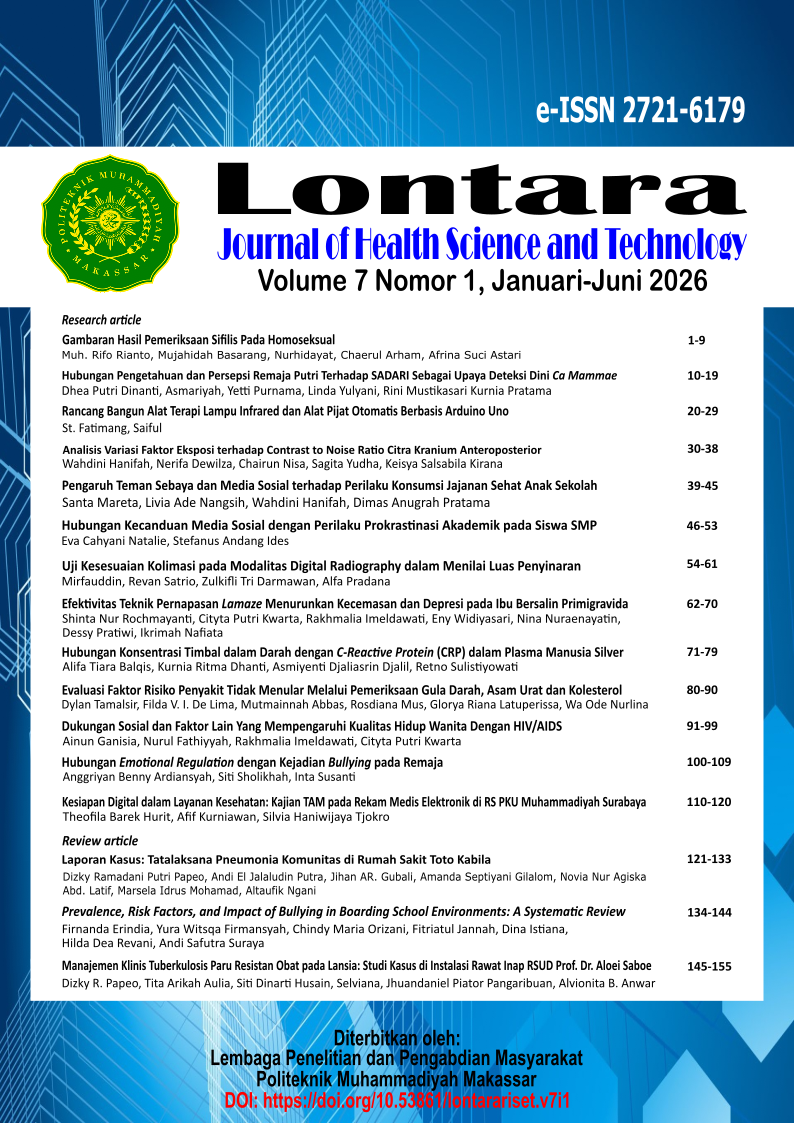
Collimation Suitability Test for Digital Radiography Modality in Assessing Radiation Field Size
DOI:
https://doi.org/10.53861/lontarariset.v7i1.609Keywords:
Collimator, Digital Radiography, Radiation Field, Conformity Test, Image QualityAbstract
The X-ray collimator is an essential device in digital radiography to ensure the accuracy of radiation field size, image quality, and patient safety. This study aimed to evaluate the collimation conformity of digital radiography equipment at the Radiology Installation of Pelamonia Hospital Makassar in determining the accuracy of radiation field size. A descriptive quantitative method was used with a collimator test tool measuring 18 × 14 cm and a source-to-image distance (SID) of 100 cm. The tests were conducted three times through direct exposure, measuring the deviation between collimator light and X-ray field. The first test showed horizontal deviation of 0.2% and vertical deviation of 0.1%. The second test recorded horizontal deviation of 0.2% and vertical deviation of 0.1%. The third test also showed horizontal deviation of 0.2% and vertical deviation of 0.1%. All results were within the tolerance limits, with individual axis deviations of ≤2% and combined total deviation of ≤3% according to national standards. In conclusion, the digital radiography equipment at Pelamonia Hospital Makassar met safety standards and is suitable for clinical use to support patient safety and optimal image quality.
Downloads
References
AAPM Task Group 150. (2015). Acceptance testing and annual physics survey recommendations for digital radiography imaging systems (AAPM Report No. 150). American Association of Physicists in Medicine. https://www.aapm.org/pubs/reports/TG-150_final.pdf
Andriani, I., & Tsania, N. P. (2024). Pengujian kolimator di instalasi radiologi RSU QIM Batang. Jurnal LONTARA Radiologi Indonesia, 5(1), 45–52. https://doi.org/10.35580/lontara.v5i1.4567
Anif, C., Suraningsih, N., & Budiwati, T. (2021). Analisis pengulangan citra digital dengan menggunakan digital radiography di instalasi radiologi rumah sakit Panti Waluyo Surakarta. Prepotif: Jurnal Kesehatan Masyarakat, 5(2), 101–108.
Badan Pengawas Tenaga Nuklir. (2022). Peraturan Kepala BAPETEN No. 2 Tahun 2022 tentang keselamatan pesawat sinar-X radiologi diagnostik dan intervensional. Jakarta, Indonesia: BAPETEN.
Isnaeni, N., Amelia, S. K., Ichzan, M., Jumardin, J., Nurrahmi, S., Agus, J., & Isradianti, D. F. (2025). Uji kesesuaian kinerja dan reproducibility akurasi tegangan tabung pesawat sinar-X di Balai Pengamanan Alat Fasilitas Kesehatan Makassar. JFT: Jurnal Fisika dan Terapannya.
Liu, J., & Kim, J. H. (2022). A novel sub-pixel-shift-based high-resolution X-ray flat panel detector. Coatings, 12(7), 987. https://doi.org/10.3390/coatings12070987
Manik, S. H., Hariyanto, H., & Abdullah, A. (2021). Uji kesesuaian cahaya kolimator dengan berkas sinar X pada pesawat sinar X digital radiography di Rumah Sakit Universitas Sumatera Utara. Cerdika: Jurnal Ilmiah Indonesia, 1(4), 378–384. https://cerdika.publikasiindonesia.id/index.php/cerdika/article/view/100
Marcellino, N., Rachmat, A., & Lestari, D. (2025). Pengaruh FFD terhadap nilai uji kolimasi pada kolimator pesawat sinar-X stasioner. Jurnal Kesehatan PDDI, 10(1). https://e-journal.hamzanwadi.ac.id/index.php/kpj/article/view/28903
Meditory, S., Artitin, C., Nisa, C., Sari, O. P., & Anjarwati, N. (2024). Uji kesamaan berkas kolimator dengan variasi jarak FFD pada pesawat sinar-X. Jurnal Syedza Saintika, 6(2), 233–240. https://doi.org/10.33104/jss.v6i2.543
Mukmin, A. (2024). Studi pengulangan citra digital pada modalitas digital radiography di instalasi radiologi RSUD Wonosari. Prosiding Seminar Nasional LPPM Universitas Aisyiyah Yogyakarta, 2, 1595–1600.
Muzdalifah, S., Dahjono, J., & Sudarsih, K. (2017). Pengujian kolimator pada pesawat sinar-X di instalasi radiologi RSUD Batang. RadX: Jurnal Ilmiah Radiologi, 2(2).
Nisa, C., Saputro, U. H., Putra, N. P., & Annazifa, S. (2023). Uji kesamaan berkas cahaya kolimator pesawat sinar-X. Jurnal Radiologi Indonesia, 4(3), 205–212.
Salsabila, N. (2024). Uji kesesuaian lapangan kolimator pada pesawat sinar-X konvensional di instalasi radiologi Rumah Sakit Indriati Solo Baru. Tugas Akhir D3 Radiologi, Universitas Muhammadiyah Surakarta.
Sari, K., & Surahmi, N. (2022). Sistem kerja penangkap sinar-X pada pesawat computed radiography di RSUD Teuku Umar Calang dan sistem kerja penangkap sinar-X pada pesawat digital radiography di RSUD Datu Beru Takengon. Jurnal Teknologi Kesehatan, 7(1), 33–40.
Seeram, E., Davidson, R., Bushong, S., & Swan, H. (2014). Image quality assessment tools for radiation dose optimization in digital radiography: An overview. Radiologic Technology, 85(5), 437–450.
Suandayani, S., Fitriani, R., & Wulandari, N. (2022). Quality control of X-rays with collimator and beam alignment test tool at fixed FFD. International Journal of Physical Sciences and Engineering, 6(3), 45–50. https://sciencescholar.us/journal/index.php/ijpse/article/view/468
Utami, A. P., Suraningsih, N., & Andriani, I. (2018). Pengujian kolimator menggunakan metode kawat “L” pada pesawat Hitachi tipe ZU-L3TY di Instalasi Radiologi RS Permata Medika Semarang. Jurnal Ilmu dan Teknologi Kesehatan.
Downloads
Published
How to Cite
Issue
Section
License
Copyright (c) 2026 Zulkifli Tri Darmawan, Mirfauddin Mirfauddin, Revan Satrio, Alfa Pradana

This work is licensed under a Creative Commons Attribution 4.0 International License.
Lontara Journal Of Health Science And Technology is licensed under Creative Commons.
The journal allows the author to hold the copyright of the article without restrictions.
The journal allows the author(s) to retain publishing rights without restrictions.
The legal formal aspect of journal publication accessibility refers to Creative Commons Attribution 4.0 International (CC BY 4.0).
The Creative Commons Attribution 4.0 International (CC BY 4.0) license allows re-distribution and re-use of a licensed work on the conditions that the creator is appropriately credited and that any derivative work is made available under “the same, similar or a compatible license”. Other than the conditions mentioned above, the editorial board is not responsible for copyright violations.