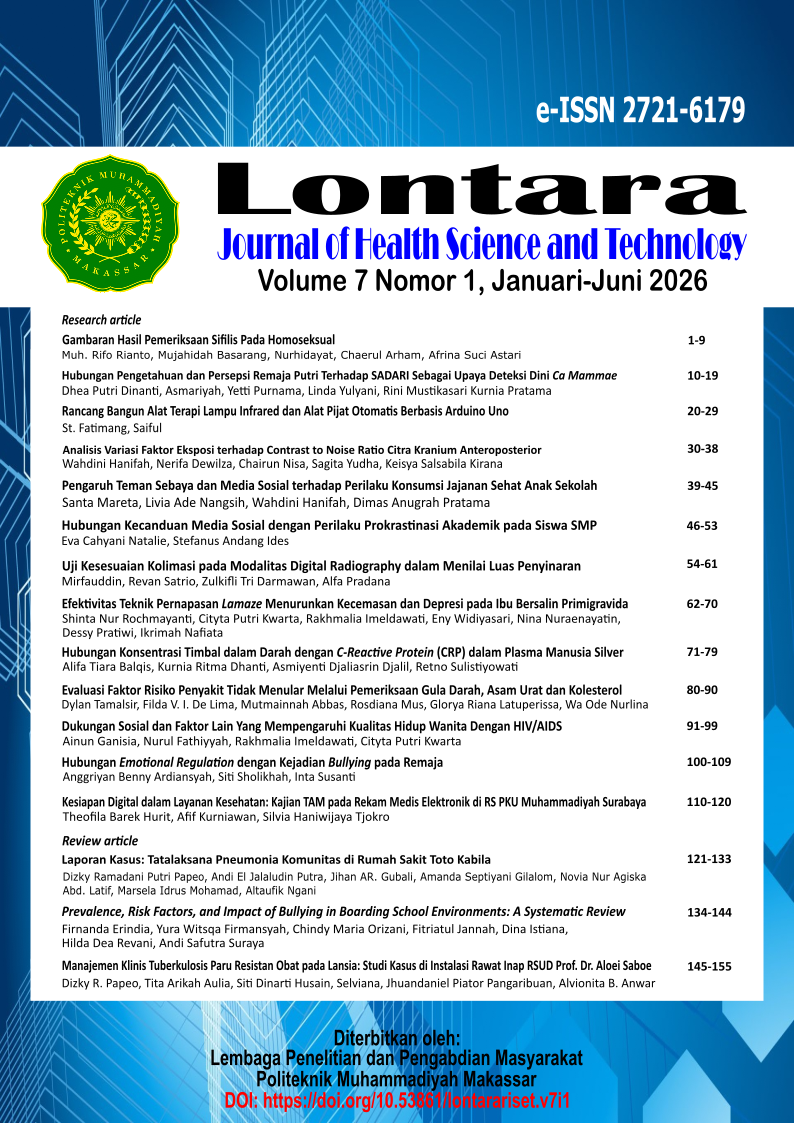
Evaluation of Non-Communicable Disease Risk Factors through Blood Glucose, Uric Acid, and Cholesterol Screening
DOI:
https://doi.org/10.53861/lontarariset.v7i1.615Keywords:
Non-Communicable Diseases, Blood Glucose, Uric Acid, Cholesterol, Risk FactorsAbstract
Non-communicable diseases (NCDs) are the leading causes of morbidity and mortality in Indonesia, with risk factors such as unhealthy diet, physical inactivity, and overweight or obesity. This study aimed to evaluate NCD risk factors through blood glucose, uric acid, and total cholesterol measurements in Negeri Leahari, Leitimur Selatan District, Ambon City. A cross-sectional design was used with a convenience sampling technique, involving 138 voluntarily participating individuals. Blood glucose, uric acid, and total cholesterol levels were measured using an AutoCheck device, while data on diet, physical activity, and body mass index were collected through questionnaires. The results showed that 30% of participants had blood glucose levels ≥200 mg/dL, 22% had hyperuricemia, and 26% had total cholesterol levels ≥200 mg/dL. The main contributing factors were unhealthy diet (58%), low physical activity (52%), and a high prevalence of overweight and obesity (38%). Analysis showed a significant relationship between low physical activity and high uric acid levels (p = 0.04), while the relationship between diet and cholesterol and blood glucose levels showed a tendency toward increase, although not statistically significant (p > 0.05). The prevalence of NCD risk factors in Negeri Leahari is relatively high, highlighting the need for education on healthy eating, promotion of adequate physical activity, and routine monitoring of blood glucose, uric acid, and cholesterol levels to reduce the risk of further complications.
Downloads
References
American Diabetes Association. (2023). Standards of Care in Diabetes - 2023. In The Grants Register 2024 (Vol. 46). https://doi.org/10.1057/978-1-349-96073-6_16356
Badan Penelitian dan Pengembangan Kesehatan Kementerian Kesehatan RI. (2019). Laporan Nasional RISKESDAS 2018. Lembaga Penerbit BALITBANGKES.
Caleyachetty, R., Thomas, N., Toulis, K. A., Mohammed, N., Gokhale, K. M., Balachandran, K., & Nirantharakumar, K. (2017). Metabolically Healthy Obese and Incident Cardiovascular Disease Events Among 3.5 Million Men and Women. 70(12). https://doi.org/10.1016/j.jacc.2017.07.763
Cohen, D. A., & Leuschner, K. J. (2019). How Can Neighborhood Parks Be Used to Increase Physical Activity? Rand Health Quarterly, 8(3). https://pmc.ncbi.nlm.nih.gov/articles/PMC6557046/
Direktorat Jenderal Pencegahan dan Pengendalian Penyakit Kementerian Kesehatan Republik Indonesia. (2023). Ditjen P2P Laporan Kinerja Semester I Tahun 2023.
Kemenkes RI. (2021). Laporan Kinerja Kementerian Kesehatan 2021. Kementrian Kesehatan RI, 23. https://e-renggar.kemkes.go.id/file_performance/1-131313-1tahunan-314.pdf
Kementerian Kesehatan Republik Indonesia. (2021). Penyakit Tidak Menular Kini Ancam Usia Muda. Sehat Negeriku. https://sehatnegeriku.kemkes.go.id/baca/umum/20200704/4434329/penyakit-tidak-menular-kini-ancam-usia-muda/
Lisnawati, N., Kusmiyatti, F., Herwibawa, B., Kristanto, B. A., & Rizkika, A. (2023). Hubungan Massa Tubuh, Persen Lemak Tubuh, dan Aktivitas Fisik dengan Kadar Gula Darah Remaja. 12(2), 168–178.
Lontoh, S. O., Jap, A. N., & Haryanto, Y. J. (2023). Penyuluhan Pentingnya Aktivitas Fisik dalam Mencegah Obesitas dan Skrining Status Gizi di Pejagalan Jakarta Barat. 1(3), 1102–1106.
Perhimpunan Dokter Spesialis Kardiovaskular Indonesia. (2022). Panduan Tata Laksana Dislipidemia 2022. PP PERKI.
Ramadhania, A. R., Hasna, A. N., & Winata, R. K. (2024). Hubungan Aktivitas Fisik dan Pola Makan terhadap Status Indeks Masa Tubuh Normal. 3(1), 58–66.
Rebel, A., Rice, M. A., & Fahy, B. G. (2012). The Accuracy of Point-of-Care Glucose Measurements. 6(2), 396–411.
Shahin, L., Patel, K. M., Heydari, M. K., & Kesselman, M. M. (2021). Hyperuricemia and Cardiovascular Risk. 13(5), 1–8. https://doi.org/10.7759/cureus.14855
World Health Organization. (2014). Global Status Report on Noncommunicable Diseases 2014. World Health Organization.
World Health Organization. (2025). NCDs at a glance 2025: NCDs surveillance and monitoring: Non-communicable disease mortality and risk factors prevalence in the Americas. In Pan American Health Organization. https://iris.paho.org/handle/10665.2/51752
Yuningrum, H., Trisnowati, H., & Rosdewi, N. N. (2021). Faktor Risiko Penyakit Tidak Menular ( PTM ) pada Remaja : Studi Kasus pada SMA Negeri dan Swasta di Kota Yogyakarta. 6(1), 41–49.
Downloads
Published
How to Cite
Issue
Section
License
Copyright (c) 2026 Dylan Tamalsir, Filda V. I. De Lima, Mutmainnah Abbas, Rosdiana Mus, Glorya Riana Latuperissa, Wa Ode Nurlina

This work is licensed under a Creative Commons Attribution 4.0 International License.
Lontara Journal Of Health Science And Technology is licensed under Creative Commons.
The journal allows the author to hold the copyright of the article without restrictions.
The journal allows the author(s) to retain publishing rights without restrictions.
The legal formal aspect of journal publication accessibility refers to Creative Commons Attribution 4.0 International (CC BY 4.0).
The Creative Commons Attribution 4.0 International (CC BY 4.0) license allows re-distribution and re-use of a licensed work on the conditions that the creator is appropriately credited and that any derivative work is made available under “the same, similar or a compatible license”. Other than the conditions mentioned above, the editorial board is not responsible for copyright violations.